Walk into a busy warehouse on a Monday morning and the floor usually isn’t the first thing you look at. You see racks stacked to the ceiling, forklifts weaving through aisles, pallets at the docks. The slab is just there in the background, doing its job quietly – right up until it starts to dust, chip, or turn into a patchwork of oil stains and tire marks. That’s when people start asking about epoxy floor paint and whether it’s really worth shutting down lanes to put it in.
Once you zoom in a little, the answer comes from chemistry more than from color charts. A good epoxy floor coating for warehouse use is basically a controlled chemical reaction poured onto concrete: resin and curing agent, cross-linking into a dense network, building a film that deals with weight, wheels and chemicals far better than the bare slab ever could. Understanding that reaction makes it easier to see why the same warehouses that run forklifts twelve hours a day keep coming back to epoxy instead of “just repainting” with a single-pack product.
Warehouse Floors: A Tough Playground for Any Coating
What the slab lives through every day
Picture a typical day in a high-bay warehouse. Forklifts track the same lines hundreds of times. Pallet jacks grind over expansion joints. At loading bays, dock plates drop onto the concrete, pallets are dragged rather than lifted, and now and then a drum leaks oil or cleaner right next to the door. Moisture blows in when the weather turns; dust and sand come in on tires; tiny chunks of concrete get crushed and spread.
Structurally, the slab can handle the load, but the surface pays the price. The top layer starts to wear and release dust. Joints chip, especially where steering wheels pivot. Stains sink deep into the pores and never really go away. In some spots the floor becomes polished-slick from constant traffic; in others, it crumbles. That’s not just a cosmetic issue. It affects safety, cleaning time, even how clearly line markings read.
Why bare concrete loses the long game
Concrete is strong in compression and pretty cheap per square meter. What it lacks is surface durability and resistance to liquids. Its pore structure is open, so water, oil and many chemicals penetrate, sit in the capillaries and slowly weaken the paste near the surface. Sweeping, scrubbing and even occasional sealing only go so far because the base material stays the same.
An industrial epoxy floor coating for warehouse use changes that by building a new, much denser layer on top of – and partially inside – the concrete surface. With the right primer and prep, the coating keys into the slab, adds hardness, reduces porosity and gives you something closer to a protective shell than to a simple color wash.
Inside the Chemistry: Raw Material of Epoxy Floor Paint
Resin and curing agent: two parts, one network
The core raw material of epoxy floor paint is a two-part system. One can holds the epoxy resin, carrying reactive epoxide groups; the other holds the curing agent (hardener), carrying the active hydrogen or other reactive sites. On their own, both components are relatively stable. The moment you mix them, the epoxide rings start to open and attach to the sites on the curing agent, and then to other epoxy chains.
That reaction keeps going until you have a three-dimensional network running through the entire film. Early on, the mix is still fluid and can wet and penetrate the concrete surface. As cross-linking builds, it gels and then hardens into a solid that will not melt or flow again under normal service temperatures. This is why a properly cured two-component epoxy floor coating for warehouse service feels so different underfoot from a basic single-pack paint.
Film structure, hardness and resistance
When the network is well balanced, you get a coating that is hard, adherent and surprisingly resistant to liquids. Academic work on epoxy resins shows that higher cross-link density generally delivers better abrasion and chemical resistance up to the point where the film becomes too brittle; good floor formulations sit in that sweet spot, hard enough to take wheels and dragging pallets, but not so glassy that they shatter under small impacts.
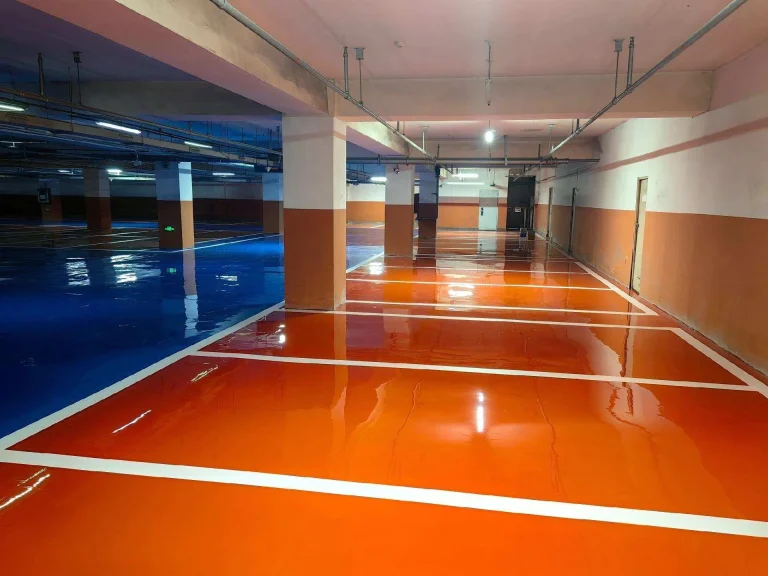
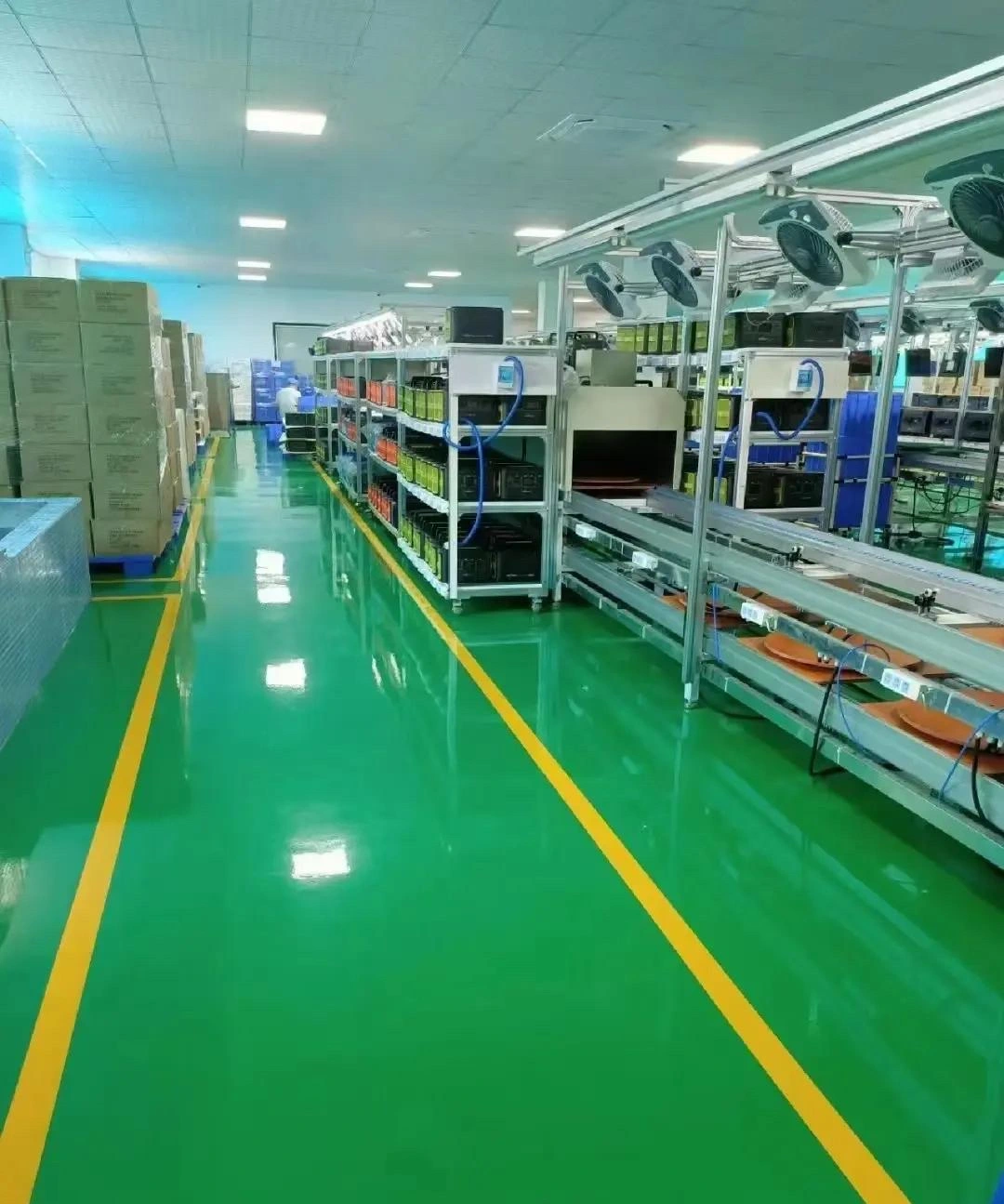
KONAZ Epoxy Floor Paint is described as an industrial-grade coating designed for superior hardness, wear resistance and chemical durability, ideal for factories, warehouses, parking lots and basements and providing a solid, clean and aesthetically pleasing flooring solution.
That product profile tells you a lot about the way the film is built: high cross-link density, tight bonding to concrete and a finish that is smooth and glossy enough to clean easily.
Pigments, fillers and additives sit on top of that basic resin-hardener framework. They control color, hiding power, flow, pot life, anti-slip behavior. But if you strip the formulation down, the performance that matters in a warehouse still comes from the raw material of epoxy floor paint: the resin, the curing agent and the network they create together.
Matching the Coating to Real Warehouse Zones
Pallet racks versus forklift highways
A warehouse floor is never one uniform condition. Under pallet racks, traffic is intermittent and mostly light. In main forklift aisles, wheels run the same tracks every few minutes. Turning circles at the ends of aisles are even tougher: every truck swings, pivots and scrubs there. At the loading docks and ramp entries, impact and dirt are the main problems.
The same epoxy floor coating for warehouse traffic can be tuned for all these areas simply by changing how it is built up. Under racks, a thinner film over a well-bonded primer may be enough; the goal there is dust control and stain resistance more than heavy abrasion. In main aisles, a thicker, self-leveling build gives the network more material to work with and spreads stress into the slab. At turning points and dock zones, many contractors specify even more build and sometimes slightly higher texture, knowing these are the spots where coating failures usually show up first.
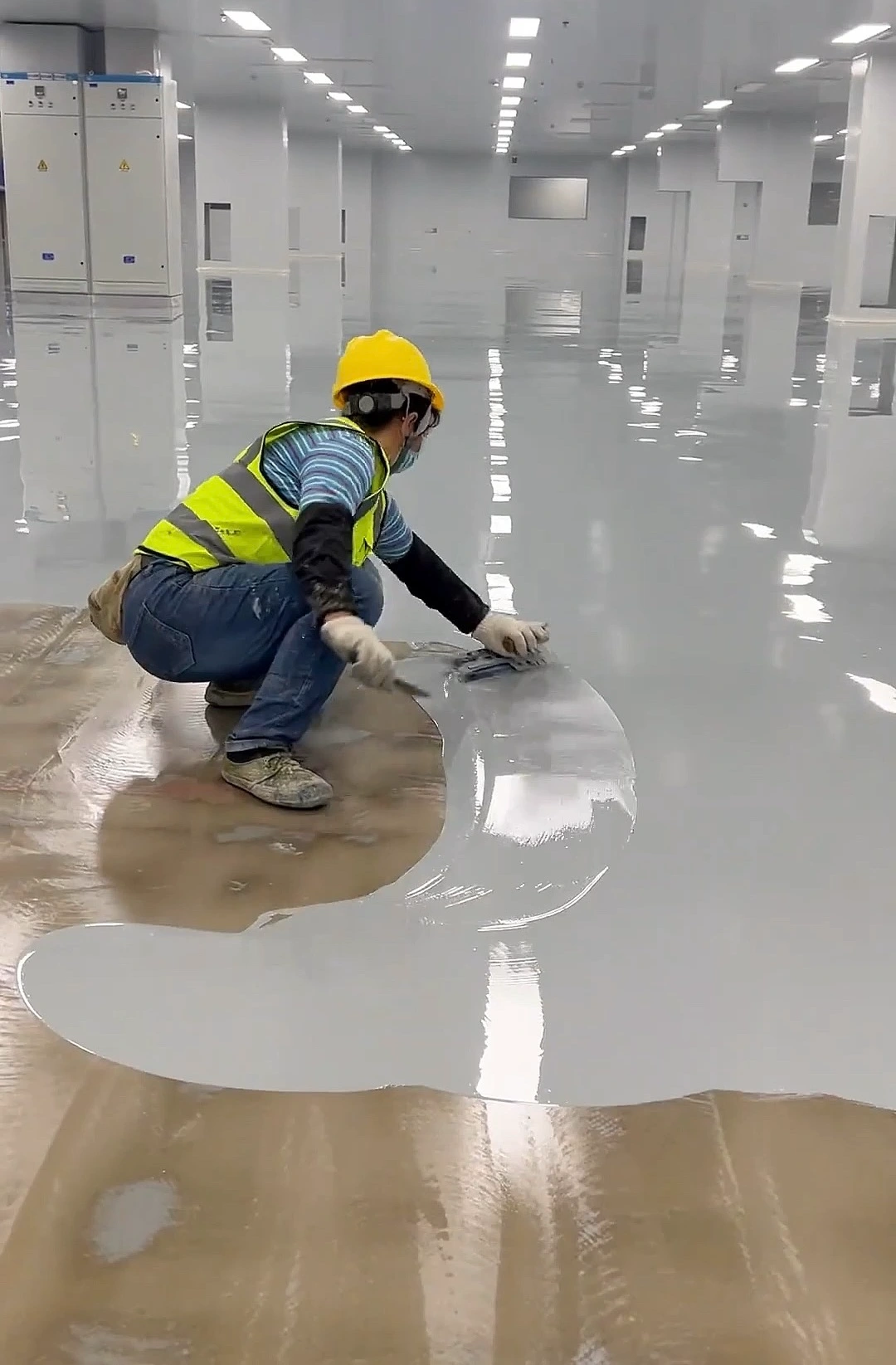
Because KONAZ Epoxy Floor Paint can be applied by trowel, roller or spray, with a theoretical coverage of 4–6 m²/kg over two coats, it fits nicely into this “different zones, same chemistry” approach: one raw material of epoxy floor paint, multiple film designs across the same warehouse.
Anti-slip where it actually matters
Smooth, glossy floors clean quickly and reflect light well, which is great for visibility. The trade-off is grip, especially when dust, moisture or oil appear. Most warehouses do not want a rough, aggressive surface everywhere; they want targeted slip resistance in the places where people and forklifts are most at risk.
With a two-component epoxy floor coating for warehouse use, this is usually handled by broadcasting fine aggregate into the wet topcoat in specific zones – ramps, dock thresholds, external doors – and then sealing it. The underlying epoxy network stays the same; the surface profile is what changes. Done right, this gives you a floor that mops clean in standard aisles but quietly supports higher friction where a small skid would be a big problem.
Curing, Drying and Getting Back to Work
Chemistry does not stop the moment you put away the roller. After mixing the resin and curing agent, the network takes time to develop. For a typical industrial system like Konaz’s, touch-dry at 25 °C is within about four hours, with hard dry – the point where heavy use becomes realistic – within roughly forty-eight hours.
From an operations point of view, that means planning. Light foot traffic may resume relatively quickly, but forklifts and pallet jacks should wait until the epoxy floor coating for warehouse traffic has reached full hardness. If you push it too early, you risk embedding dirt, printing tire patterns into a film that is still moving, or even tearing the surface where it crosses hairline cracks. If you respect the curing time, you get the long-term benefits the chemistry was designed to deliver: a hard, tightly bonded film that handles heavy wheels and regular scrubbing without peeling.
Once it is cured, daily life is easier. Dust tends to sit on top of the coating instead of emerging from it, so scrubbers and vacuums actually make progress. Oil spills stay at the surface longer, giving staff more time to react. Line markings and color-coded zones stay visible instead of fading into a grey, patchy background.
Where Konaz Epoxy Floor Paint Fits in Warehouse Projects
The English product sheet for KONAZ Epoxy Floor Paint calls it an industrial-grade coating with high hardness and excellent wear resistance, resistant to oil, chemicals and corrosion, with a smooth and glossy finish and low maintenance requirements.
It is presented as suitable for industrial workshops, parking lots, warehouses and logistics centers, basements and other commercial and industrial floors.
For warehouse operators, that combination matters. The raw material of epoxy floor paint in this case is clearly aimed at serious traffic, not just light decorative use. Two-component packaging, a defined coverage range and a drying profile that fits weekend or phased shutdowns make it easier to schedule work. At the same time, the film properties – hardness, chemical resistance, gloss – line up directly with the pain points most warehouses talk about: dusting, staining, difficult cleaning and poor light levels.
Because Konaz builds and publishes both epoxy and other industrial coatings, its technical team is used to thinking in terms of long-term performance under heat, corrosion and mechanical stress, not just how a floor looks on day one. That mindset carries over into how their epoxy floor systems are positioned for concrete and warehouse use.
About Foshan Konaz Technology Co., Ltd
Foshan Konaz Technology Co., Ltd is based in Foshan, Guangdong, with a background in high-performance coatings for demanding environments. The company has focused on heat-resistant paints, anti-rust systems and specialty coatings and has built a modern plant with around 3,000 square meters of factory space, more than thirty pieces of production equipment and an annual output on the order of one thousand tons.
Over more than fifteen years of development, Konaz has moved from serving mainly domestic customers to supplying international markets, with its products recognized for durability and stability in real-world use. Epoxy floor systems now sit alongside its high-temperature and anti-corrosion coatings, giving warehouse, factory and parking-deck clients a single source for both the raw material of epoxy floor paint and related protective technologies. For B-side customers, that means one manufacturer can support everything from floor upgrades in logistics hubs to protective schemes on equipment that shares the same building.
Conclusion
If you treat epoxy floor paint as just another way to “color” a warehouse slab, it is hard to justify the shutdown time and prep work. Once you see it as a controlled reaction between resin and curing agent that turns the raw material of epoxy floor paint into a dense, cross-linked shell over your concrete, the picture looks different. You are not only changing how the floor appears; you are changing how it behaves under load, under wheels and under chemicals.
In practical terms, that means dust stays under control, cleaning becomes closer to wiping down a countertop than fighting porous stone, and heavy traffic follows clear, durable markings instead of wearing them away. It also means that the worst parts of a warehouse – turning circles, docks, damp basements – can be given tailored film builds and slip resistance without sacrificing the overall look and feel of the space.
With a system like KONAZ Epoxy Floor Paint, built on industrial-grade raw materials and supported by a coatings manufacturer that understands tough conditions, epoxy floor coating for warehouse use stops being a one-off project and becomes part of how the facility runs. The chemistry does the quiet work in the background so the operation can keep moving in the foreground.
FAQs
What exactly is the raw material of epoxy floor paint in a warehouse system?
In a warehouse-grade system, the raw material of epoxy floor paint is mostly a liquid epoxy resin and a matching curing agent. When they are mixed, those two form the cross-linked network that gives the coating its hardness, adhesion and resistance to oils and cleaners. Pigments and fillers are there too, but they sit on top of that resin-hardener backbone.
Why not just use a single-pack paint on the warehouse floor?
Single-pack products are easier to store and apply, but they do not build the same kind of network you get from a two-component epoxy floor coating for warehouse traffic. Without that full cross-linking between resin and curing agent, films tend to be softer, less resistant to chemicals and more likely to wear through under forklifts and pallet jacks.
How long should I keep forklifts off a new epoxy floor?
With a typical two-component epoxy floor coating for warehouse use, you can usually walk on the surface after about a day at normal shop temperatures, but heavy traffic should wait closer to forty-eight hours to let the film reach hard dry. That window lets the network finish forming so wheels do not scar or crush a coating that is still curing.
Do all parts of the warehouse need the same epoxy floor thickness?
Not really. Under racks and in lightly used corners, a thinner build of epoxy floor coating for warehouse floors often works well. In main forklift aisles, turning zones and loading bays, most contractors step up to thicker, sometimes self-leveling layers and add a bit of texture for grip, using the same basic resin and curing agent but a different film design for the tougher spots.