If you’ve ever walked through a wind farm before sunrise—especially near the coast—you already know turbines live in a very unforgiving environment. The air feels damp even on a clear day, and there’s usually a salty film on anything made of metal. Stand close to a tower base and you might notice tiny rust specks around the bolts or along the lower seams. They don’t look like much at first, but anyone who has maintained turbines for a while knows those little spots rarely stay little.
Wind turbines may look calm and balanced from a distance, spinning quietly over farmland or offshore waters, but the equipment is under continuous stress. Moisture never fully disappears, vibration travels through the tower even when winds are light, and temperature swings happen faster than most newcomers expect. Many onshore turbines deal with wind-driven dust and strong UV exposure; offshore units face salt spray that dries on the tower like a layer of abrasive grit. Left alone, that combination slowly eats through any unprotected steel.
This is exactly why anti rust paint isn’t treated as a simple finishing material in wind power. It’s more like a routine safeguard—just as essential as torque checks or blade inspections. A dependable coating buys time, delays expensive repairs, and keeps turbines running when they should be producing. In this industry, downtime is the enemy, and good coatings are one of the few tools that directly help fight it.

Why Wind Turbines Face an Accelerated Corrosion Environment
Wind turbines work in a constantly shifting climate. They face stronger corrosion stressors than most land-based steel structures:
Salt-laden air, especially offshore
Salt crystals cling to tower surfaces, attracting moisture and accelerating oxidation.
Condensation inside towers and nacelles
Warm air inside the structure meets cold steel walls, creating persistent moisture droplets on platforms, ladders, and internal beams.
Strong UV exposure
Sunlight breaks down weak coatings, causing chalking and reducing protection.
Continuous vibration
Even minor vibration can cause rigid coatings to crack over time.
Rapid temperature changes
Steel expands during the day and contracts at night. A coating must stretch with it or micro-cracks form.
Wind turbine coatings must withstand all these stresses—often simultaneously.
Where Corrosion Usually Appears First
Technicians climbing turbines usually notice the same trouble spots:
Tower Bases
The lowest section sees water splash, salt accumulation, and standing moisture—especially offshore.
Flanges and bolt areas
Moisture easily becomes trapped here. Even small gaps can trigger corrosion rings around bolts.
Nacelle roofs and internal steel frameworks
Warm internal air combined with cold metal encourages condensation and rust.
Yaw and pitch system metal parts
These moving components can’t tolerate corrosion because it affects precision mechanics.
Blade root metal components
The composite blades attach to steel elements that require strong corrosion protection.
These areas often require rope-access crews and special equipment, making repairs significantly more expensive than preventive coating work.
What Makes an Anti Rust Paint Suitable for Wind Turbines
Wind turbines need coatings that go far beyond basic rust prevention.
Strong adhesion to steel
Corrosion spreads fastest when a coating lifts or peels. Konaz formulations are known for stable adhesion even when condensation is present.
High resistance to moisture and salt
Saltwater, sea fog, and humid air push coatings to their limits. Offshore turbines rely on this resistance above all else.
Hardness to withstand abrasion
Wind carries sand, dust, and salt that constantly hit tower surfaces. A harder coating survives longer.
Flexibility under vibration
Because the tower vibrates daily, rigid coatings tend to crack. Elasticity helps extend coating life.
Flexible application methods
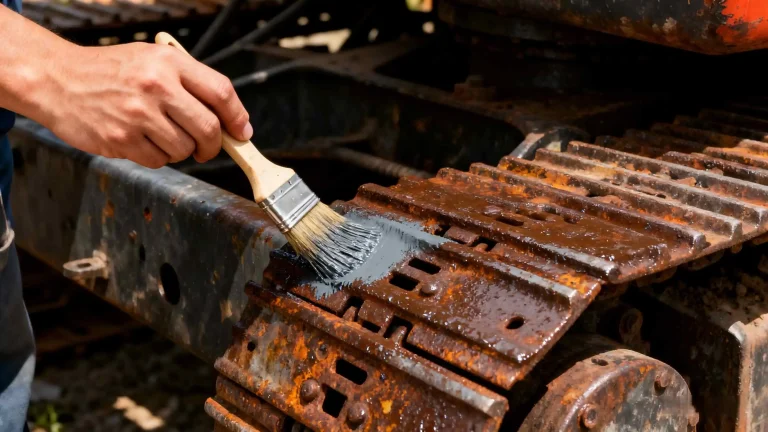
Spray guns, rollers, and brushes must all be usable because space is limited inside towers and nacelles.
Konaz paints support all three methods.
Practical drying time
Weather windows are unpredictable. Coatings that dry to touch within a couple of hours help crews work more efficiently.
Common Anti Rust Paint Systems Used in Wind Power
Anti rust primers (red oxide, grey)
Used as a first layer to protect bare steel and strengthen adhesion.
Konaz offers both types, widely used on tower interiors and nacelle structural frames.
Heavy-duty corrosion-resistant coatings
Designed for salt-rich or high-moisture areas such as offshore towers and coastal regions.
Multi-layer protective systems
A primer + intermediate coat + UV-resistant topcoat combination is common for offshore turbines.
Offshore Turbines: Why They Need an Even Stronger Coating System
Offshore wind farms deal with more severe environmental forces:
- Constant salt spray
- High humidity outside and inside the tower
- Strong reflection from sunlight on the sea surface
- Storm-driven abrasion
- High repair costs due to access limitations
Coating failures offshore often require vessels, crane support, or rope-access teams—any of which can multiply maintenance costs. A resilient anti rust paint system dramatically reduces these risks.
About Foshan Konaz Technology Co., Ltd
Foshan Konaz Technology Co., Ltd produces protective coatings for steel structures, industrial equipment, pipelines, and the energy sector. Many of these applications overlap naturally with wind power, where corrosion resistance and adhesion stability are essential.
Konaz coatings are frequently selected by wind turbine manufacturers and maintenance teams because:
• They bond well even in humidity-heavy conditions
Perfect for tower interiors and nacelle structures.
• Their corrosion resistance suits coastal and offshore environments
Salt-heavy air requires a higher grade of rust protection.
• Application methods match real field conditions
Brushing, rolling, and spraying are all possible regardless of space limitations.
•Drying times fit short weather windows
Technicians can recoat within the same shift.
• Stable production supports large, ongoing turbine orders
This reliability matters for tower factories and major maintenance contractors.
Konaz coatings integrate smoothly into wind turbine maintenance routines and help prevent rust-related failures before they escalate.
Conclusion
Corrosion on wind turbines doesn’t shout for attention—it starts quietly. A small rust patch at a flange, a blister forming near a tower joint, a faint discoloration inside the nacelle. Ignore those signs for a few months and the cost of fixing them often jumps dramatically. Anyone who has managed wind turbines in the real world knows the pattern well.
A dependable anti rust paint system slows this process and gives operators more control. It reduces emergency repairs, keeps turbines producing power instead of waiting for weather windows, and helps extend the life of major components. Wind power depends on uptime, and coatings play a direct role in protecting that uptime.
Konaz coatings were formulated with these real-world conditions in mind—wind, moisture, vibration, and the practical challenges of field maintenance. They don’t promise miracles, but they do provide a strong, reliable layer of protection that pays off over the long haul.
FAQs
Which parts of a wind turbine tend to rust first?
The tower base, flange areas, nacelle roof, and internal steel frames usually show rust earlier because they’re exposed to moisture or salt accumulation.
Can anti rust paint be applied inside the nacelle?
Yes. Internal brackets and steel frames inside the nacelle often face condensation, so protective coatings are helpful.
Do offshore turbines require a different coating system?
Typically yes. Offshore turbines need coatings with stronger salt-spray resistance due to continuous exposure to marine air.
How long does a coating usually last?
It varies by site. Offshore turbines may need touch-ups sooner, while inland sites can go longer between recoating cycles.
What makes Konaz coatings suitable for wind turbines?
They offer strong adhesion, good corrosion resistance, flexible application methods, and consistent batch quality—helpful for both tower manufacturing and field maintenance.