If you’ve ever walked on an offshore platform—whether it’s a drilling rig or a wind turbine tower—you notice one thing immediately: almost everything is steel, and almost everything is fighting corrosion. There’s salt in the air, humidity everywhere, and surfaces that stay damp long after the sun comes up. Maintenance crews joke that “rust never sleeps,” and in a marine environment, that line isn’t far from the truth.
This is exactly why anti rust paint isn’t just another coating. Offshore teams rely on it the same way they rely on safety gear—because when corrosion wins, the structure loses strength, bolts weaken, and equipment starts behaving unpredictably.
This article takes a practical look at why certain coatings last offshore and why some fail much faster than expected. It also draws from the know-how of suppliers like Foshan Konaz Technology Co., Ltd, whose coatings have been used on steel structures, machinery frames, and marine engineering equipment.
Why Offshore Platforms Need Serious Anti-Corrosion Protection
Steel reacts aggressively in marine environments. It’s the constant mix of salt, moisture, sunlight, and physical abrasion that makes offshore corrosion so much worse than what we see on land.
Here’s what the steel is dealing with every single day:
- Salt spray coating surfaces from dawn to dusk
- High humidity making the steel “sweat”
- Temperature swings that cause expansion and contraction
- Sand and particles carried by wind
- Tools, boots, hoses, and cables hitting the surface
One offshore engineer once said during an inspection:
“You don’t paint offshore steel to make it pretty. You paint it so it survives the year.”
And he’s right. Without a strong anti rust system, even thick steel beams start showing pitting within months. That pitting eventually grows into cracks, and cracks eventually become structural headaches.
What Makes Anti Rust Paint Work in Marine Conditions
Not all coatings behave the same in marine environments. The ones that survive share a few traits—not fancy textbook language, just things that experience teaches you to look for.
A coating that grips steel tightly
When a coating begins peeling offshore, it always starts at an edge or a weld. Once moisture gets underneath the paint, the corrosion spreads faster than most teams can keep up with.
Konaz formulates coatings to bond firmly to steel, even in moisture-heavy areas.
Real corrosion resistance—not just a label claim
Marine corrosion isn’t theoretical; it’s aggressive. A good anti rust paint must handle oxidation, salt spray, and humidity at the same time.
Konaz coatings are developed with this in mind and offer reliable protective layers against salt and moisture.
A film that takes abuse
Steel surfaces offshore get knocked around—wrenches, boots, hoses, moving equipment. That means the coating needs to be hard enough to resist abrasion but flexible enough to tolerate expansion.
Practical application methods
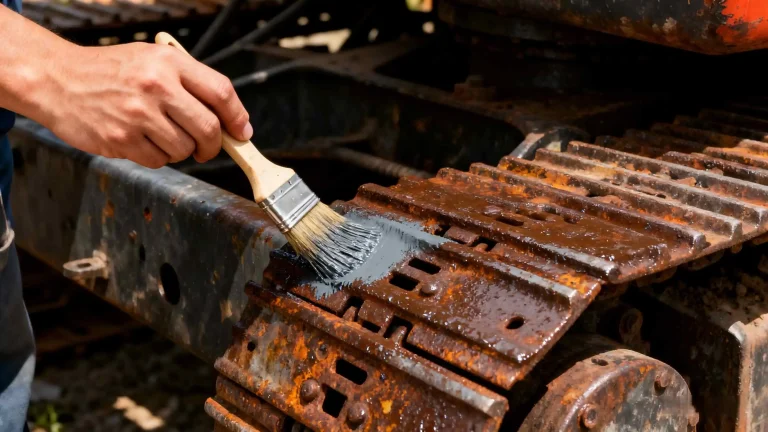
Offshore platforms are full of cramped spaces. Painters often work on narrow walkways, under decks, or on ladders. Coatings that work with spray, brush, or roller make the job doable.
Konaz paints can be applied in all these ways, which helps crews complete coating work efficiently.
Drying fast enough for offshore schedules
Waiting half a day for a coat to dry isn’t realistic when weather changes by the hour. A coating that dries in roughly two hours helps teams finish work before wind or rain rolls in.
Where Anti Rust Paint Gets Used on Offshore Structures
Pretty much every steel surface needs protection—some more urgently than others. Typical areas include:
- Primary steel beams
- Crane structures
- Staircases and handrails
- Pipe racks
- Machinery housings
- Offshore wind turbine towers
- Storage tanks
- Helideck supports
- Cable tray supports
The splash zone—the part of the structure between high and low tide—is notorious for the fastest corrosion. Anyone who has maintained a platform knows: if your coating survives the splash zone, it’ll survive anywhere.
Coating Types Commonly Used Offshore
Although there are dozens of formulations out there, several categories show up repeatedly in offshore work.
Red Oxide Primer (Cost-Effective Workhorse)
Still one of the most recognizable primers. Often used as the first layer.
Pros:
- Good adhesion
- Reliable performance
- Affordable for large steel areas
Konaz supplies red oxide and grey oxide primer options.
Best for:
General steel structure base layers.
Enhanced Anti-Corrosion Paint
These are heavier-duty coatings meant to handle harsher conditions.
Best for:
- Splash zones
- Deck edges
- Exposed steel frames
They’re essentially the “frontline soldiers” against saltwater and humidity.
Marine Coating Systems (Multi-Layer)
Sometimes a single coating isn’t enough. Offshore projects often use multi-layer systems with primers, intermediate coats, and UV-resistant topcoats.
Best for:
- Wind turbine towers
- Lifeboat stations
- High-value structural components
Protective Coatings for Pipelines and Tanks
Pipeline coatings need to resist constant moisture and, sometimes, chemical exposure.
Konaz provides protective paints suitable for tanks and pipelines used on offshore facilities.
How Marine Environments Accelerate Corrosion
You can test a coating in a lab all day long, but offshore conditions stress it differently. Salt particles creep into every small scratch. UV light weakens poorly formulated paint. High humidity keeps steel wet at all hours. Add physical impact to the mix, and corrosion becomes inevitable without strong coatings.
I’ve heard maintenance supervisors explain it this way:
“We’re not trying to beat corrosion forever. We’re trying to keep it under control long enough to stay safe and efficient.”
That’s why the choice of coating is so critical.
A Closer Look at Foshan Konaz Technology Co., Ltd
Foshan Konaz Technology Co., Ltd develops protective paints specifically for steel structures, mechanical equipment, and marine conditions. The company focuses on creating coatings that stand up to real-world environments—including the kind of constant humidity and salt exposure offshore teams are familiar with.
Here’s what customers often highlight after working with Konaz:
• Adhesion that lasts longer in salt-heavy zones
Peeling paint is a major problem offshore, and Konaz’s bonding performance helps reduce that.
• Strong resistance against oxidation and moisture
These coatings help prevent the base steel from rusting prematurely—even in challenging marine environments.
• Flexible application options
Crews can apply the coating using spray, brush, or roller, depending on the workspace.
• Practical drying speeds
This helps keep maintenance schedules realistic for offshore environments.
• Supply stability for engineering projects
Large projects need consistent batches, and Konaz can supply at that scale.
All these details matter to offshore operators who can’t afford unexpected failures or mid-cycle maintenance.
Conclusion
Keeping steel alive offshore is a never-ending battle. Anyone who has done maintenance work on a platform knows how quickly salt and humidity chew through unprotected surfaces. And once rust takes hold—especially around weld seams or in the splash zone—you’re not just dealing with touch-ups. You’re dealing with real structural consequences.
That’s why the coating choice matters long before a platform sees its first wave. A good anti rust paint doesn’t shout for attention, but you notice its value years later when the steel still looks solid and the maintenance budget hasn’t blown up. Adhesion, corrosion resistance, film strength, and application flexibility—these aren’t marketing words offshore; they’re the difference between scheduled work and emergency repairs at sea.
Konaz has built a reputation with teams who work around metal every day. Their coatings don’t just check boxes—they behave predictably in the kind of conditions offshore crews deal with, which is ultimately what operators need. If you’re trying to stretch maintenance cycles, cut down unplanned corrosion work, or simply keep your steel from fading before its time, choosing a dependable anti rust paint is one of the smartest decisions you can make.
FAQs
What type of anti rust paint usually holds up best offshore?
Coatings that bond tightly to steel and don’t soften under salt spray tend to last longest. In offshore environments, the real test is whether the paint stays attached after months of moisture and sun—not just the first week after application.
Why does corrosion happen so fast on offshore steel?
It’s the mix of salt, humidity, and UV exposure. Salt makes steel corrode faster, humidity keeps the surface damp, and sun breaks down weaker paints. Put all three together, and rust spreads much quicker than on land.
Can the same anti rust paint be used on tanks and pipelines offshore?
Yes, as long as the paint is formulated for metal structures and can handle constant moisture. Many offshore operators use the same system on beams, machinery frames, and pipelines because consistent performance makes maintenance easier.
How often do offshore structures typically need repainting?
There’s no universal schedule. On well-protected steel, 5–7 years isn’t uncommon. On parts constantly exposed to waves or abrasion, crews may repaint certain areas every couple of years.
How does Konaz help offshore operators reduce corrosion problems?
Konaz focuses on coatings that cling well to steel, resist salt-heavy environments, and dry quickly enough for offshore work windows. Their products are built around the realities of marine engineering, not just lab conditions, which is why many project teams continue choosing them.