Walk into a busy parking garage during rush hour and the floor tells you everything you need to know. Dark arcs on tight corners, polished tracks on ramps, oil halos under the same few spaces, stall lines that have faded to a vague guess. When that story gets too loud, owners and contractors usually end up at the same question: which epoxy floor paint for garage projects will actually hold up, and which ones are just a cosmetic refresh.
For high-traffic parking structures, the right epoxy system is less about picking a nice grey and more about matching chemistry, film build and surface texture to real pain points: tire wear, oil contamination, hard-to-clean markings and slippery slopes. Once you look at a parking deck as a set of different zones instead of one big slab, it becomes easier to see why a proper epoxy floor paint is the go-to choice and where a product like the KONAZ Epoxy Floor Paint line fits into the picture.
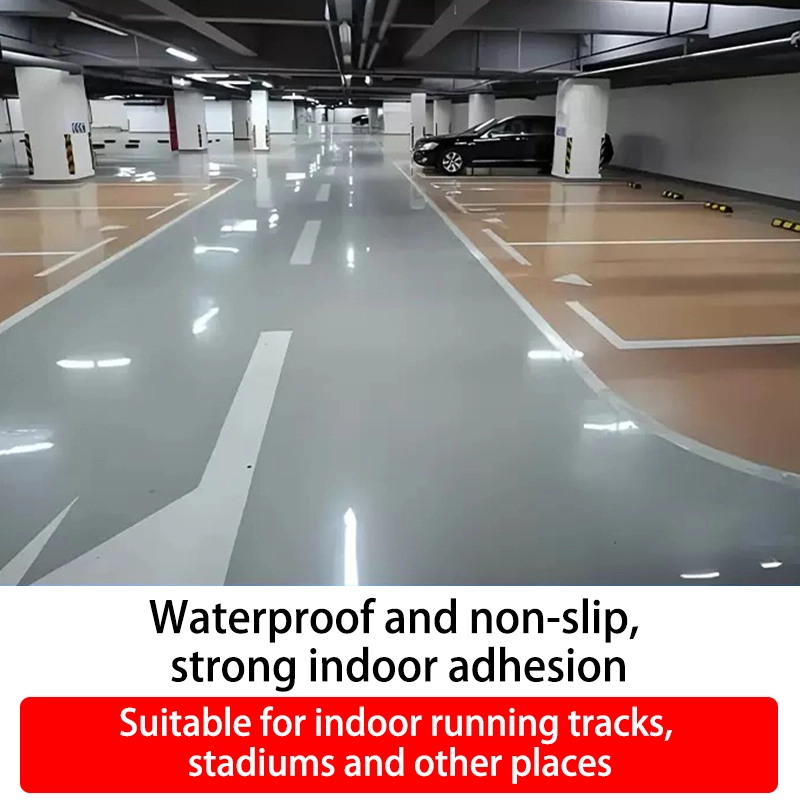
What Really Destroys Parking Garage Floors
Tire friction and hot rubber
Every car that rolls into a garage brings two enemies: weight and friction. In straight lanes the tires mostly roll, but at ramps, curves and tight stalls they scrub sideways. Over time, that scrubbing polishes bare concrete or weak coatings until the surface turns glassy-smooth. When it rains or snow melts off the underbody, those shiny paths are exactly where cars lose grip first.
Hot rubber also leaves tough marks. On ordinary paint, those marks sink into the film and become part of the color. On plain concrete, they embed into the pores. Many older garages end up with black “snake trails” that no amount of mopping will remove. A high-solids epoxy floor paint for parking garage floors creates a harder, denser film, so rubber stays more on the surface and can be attacked with scrubbers instead of living there permanently.
Oil, brake fluid and the always-dirty look
Even in well-maintained garages, there are always a few cars that drip. Engine oil at the back of the space, a bit of brake fluid near the pillars, coolant near the entrance after a breakdown. On bare concrete, these fluids soak in, darken the slab and often react with cement paste. On cheap coatings, they soften the film or leave permanent stains. Over time, the floor starts to look dirty even when it is freshly cleaned.
With a proper epoxy floor paint for garage decks, the cured film is much more resistant to oil and common automotive chemicals. That does not make the floor immune, but it slows absorption and keeps more contamination at the surface where it can be washed away. For operators, that can mean the difference between a structure that always looks tired and one that still feels like part of a premium property after years of use.
Slippery ramps, tight curves and fading markings
The third big issue is safety. Ramps and slope changes are risky by definition. When the surface is worn smooth and dusted with fine powder from the slab, they become skid zones. Add faded arrows and stall lines and drivers start improvising, which is the last thing you want in a confined multilevel garage.
Because a high-grade epoxy floor paint for parking garage floors can be tuned with anti-slip textures and strong, stable color, it becomes a functional part of the traffic management system: it directs drivers, protects pedestrians and helps keep cars under control on wet mornings when conditions are at their worst.
Why Epoxy Works Better Than Plain Concrete or Ordinary Paint
From porous slab to cross-linked film
Concrete is an excellent structural material, but as a finished surface it has flaws that matter in a garage. It is porous, it micro-cracks, and the very top layer can be relatively weak. Water, oil and de-icing salts get into that top layer and begin a slow, constant attack.
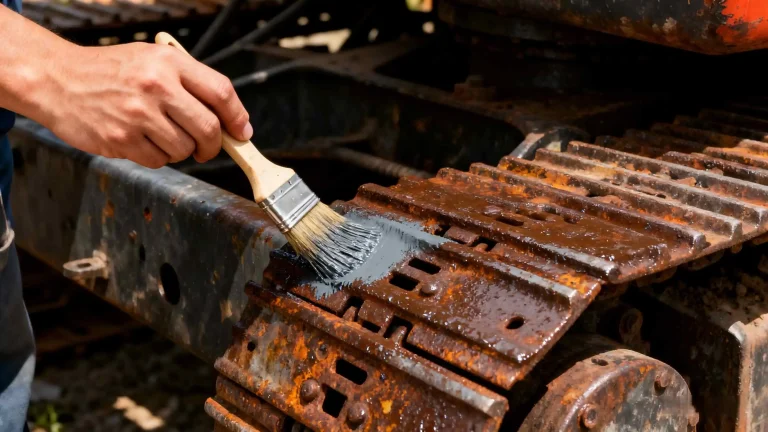
A good epoxy floor paint for parking garage floors starts with surface preparation and a primer that wets and penetrates the concrete. The main epoxy layer is a two-component system: resin and hardener react to form a cross-linked network that bonds tightly to the primed slab. You go from an absorbent, dusty surface to a compact film that is much more resistant to traffic and liquids.
On the KONAZ site, the epoxy floor paint is described as an industrial-grade coating designed for superior hardness, wear resistance and chemical durability, ideal for factories, warehouses, parking lots and basements and providing a solid, clean and aesthetically pleasing flooring solution. That’s exactly the combination a commercial garage needs.
High-solids epoxy versus “garage paint in a can”
Not every product with “epoxy” on the label behaves the same way. One-part “garage paints” are often fine for a small home garage that sees light use, but they are not built for thousands of vehicles a day or constant turning and braking.
A genuine epoxy floor paint for garage projects in commercial settings is usually high-solids and truly two-component. Once mixed, it builds a thicker, tougher film in fewer passes. That extra build and cross-linking density is what lets a deck carry SUVs, delivery vans and daily commuters without showing deep ruts at every corner after a single winter.
Different Parking Zones, Different Design Choices
Ramps and slope transitions
Ramps are the most unforgiving part of a garage. Here, choosing epoxy floor paint is not just about color; it is about slip resistance, thickness and layout. Most projects use a system approach: primer, a high-build epoxy body coat, then a topcoat loaded with fine aggregate to increase friction.
A well-designed epoxy floor paint for parking garage ramps will feel slightly rough underfoot but not so aggressive that it chews tires or traps dirt. The goal is a surface that grips in both dry and wet conditions and that maintenance crews can still clean with ride-on scrubbers. Color bands on the ramp, created with different epoxy topcoats, can also guide drivers visually and highlight pedestrian areas.
Parking bays and straight lanes
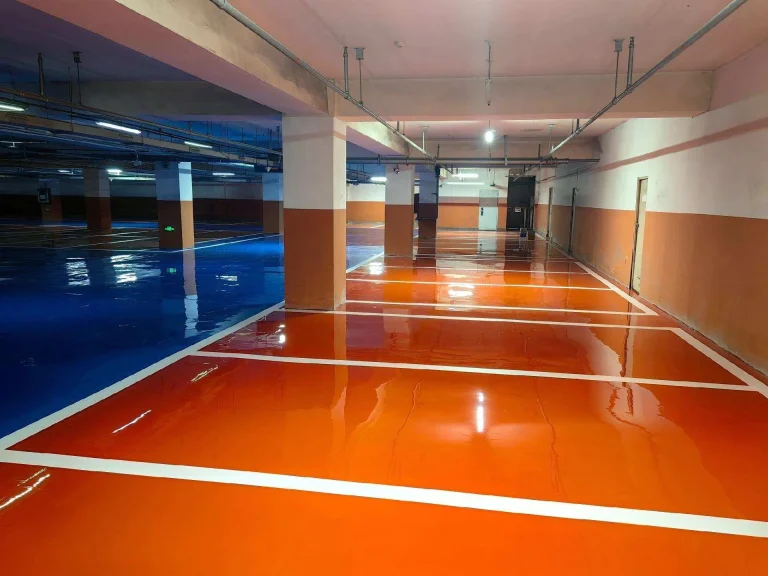
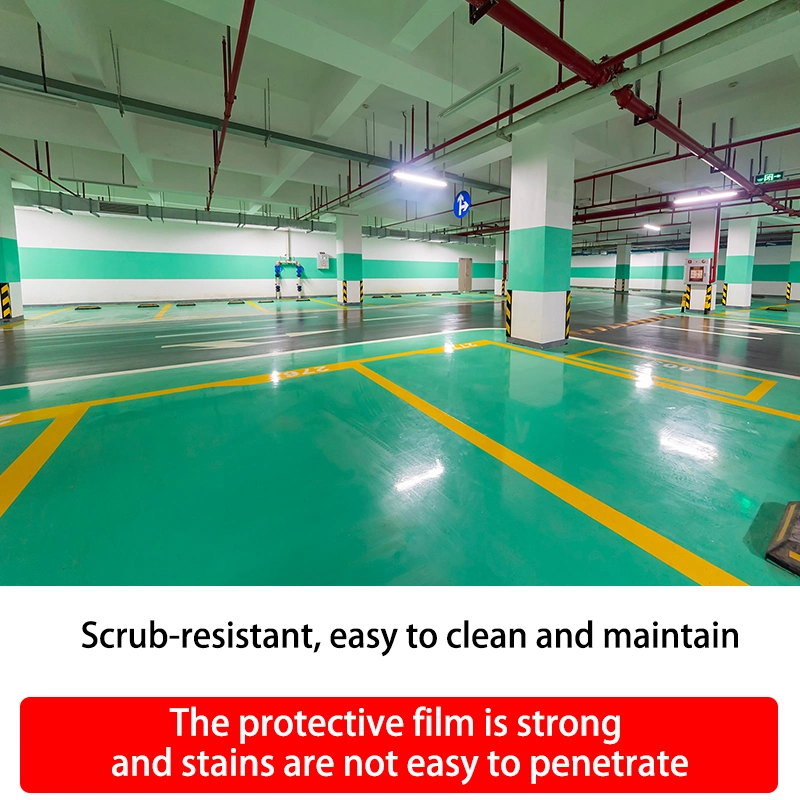
In the stalls and straight drive aisles, the picture changes. Loads are lighter, speeds are lower, and aesthetics matter more. A smoother, glossy epoxy floor paint for garage stalls makes sense here. It brightens the space by reflecting light, supports crisp stall lines and directional arrows, and is easy to mop or machine clean.
Because KONAZ Epoxy Floor Paint is supplied as a two-component system with good adhesion and gloss, and is suitable for parking lots as well as industrial floors, it fits naturally into this kind of zoned design: heavy-duty, textured builds where needed, smoother decorative builds in the rest of the deck.
Underground versus open-air levels
Underground garages are often humid with limited natural light. Open-air decks may see UV exposure and more drastic temperature swings. Epoxy floor paint for parking lot projects has to respect those differences. In underground levels, you want good moisture control at the concrete surface, light colors and high gloss to bounce artificial light back into the space, and chemical resistance against exhaust and drips. On exposed decks, joint detailing and compatible topcoats become more important, and sometimes the epoxy layer is combined with additional UV-resistant finishes in fully open areas.
Foshan Konaz Technology Co., Ltd and Garage Epoxy Systems
Foshan Konaz Technology Co., Ltd is based in Foshan, Guangdong. The company has focused for more than fifteen years on functional coatings such as heat resistant paints, specialty industrial coatings and protective systems for demanding environments. It operates a modern factory of about 3,000 square meters with more than thirty pieces of production equipment and an annual output around 1,000 tons, supplying both domestic and international markets.
Within that broader portfolio, epoxy floor paint is one of the key product lines. The KONAZ Epoxy Floor Paint range combines high hardness, wear resistance and chemical durability with a smooth, glossy finish, and is explicitly positioned for factories, warehouses, parking lots, basements and other commercial and industrial floors. That means when you specify an epoxy floor paint for garage upgrades through Konaz, you are not buying a retail coating; you are working with a manufacturer whose core business is long-life, performance coatings for tough service.
For B-side customers such as contractors, project owners and facility managers, that matters. You get access to product data, film build recommendations, curing schedules and zone-specific suggestions drawn from industrial practice, not just a brochure.
Conclusion
In a high-traffic parking structure, the floor is not just a background surface. It is a safety device, a branding element and a daily maintenance cost all rolled into one. Choosing the right epoxy floor paint for garage use is really about deciding what you want that floor to look like and how you want it to behave five or ten years from now.
Plain concrete loses that argument early. Thin, one-part paints usually follow soon after, giving you a short-lived cosmetic fix. A properly designed epoxy system, built around a high-solids two-component product like KONAZ Epoxy Floor Paint and tailored to ramps, stalls and underground levels, changes the equation. You get a dense, cross-linked film that stands up to tires, oil and weather, that keeps markings readable and that can be cleaned without a battle every night.
For owners and operators who see their garage as part of the overall value of the property, not just a necessary expense, that is the real reason to take epoxy floor paint for parking garage floors seriously and to treat it as a system choice, not a last-minute afterthought.
FAQs
Do I really need a two-component epoxy floor paint for a commercial parking garage?
For a small private garage, a simple coating may be enough. In a multi-level or high-turnover facility, a two-component epoxy floor paint for garage decks gives you the cross-linked film and thickness you need to handle hot tires, constant turning and regular cleaning without peeling or wearing through too quickly.
How long should a newly coated deck stay closed before cars come back in?
With a system based on KONAZ Epoxy Floor Paint applied at normal thickness and around twenty-five degrees Celsius, the surface is usually touch-dry within a few hours but needs up to about forty-eight hours to reach hard dry. That is the point when an epoxy floor paint for parking garage floors has built enough strength to accept full traffic without scarring right away.
Can one epoxy floor paint system work for both ramps and flat bays?
Yes, but the build changes. Many projects use the same base epoxy floor paint for garage slabs throughout, then add more thickness and anti-slip texture on ramps and tight curves while keeping a smoother, glossy finish in parking bays and straight lanes. The chemistry stays consistent; the film design varies by zone.
Is epoxy floor paint suitable for older, stained concrete decks?
Old slabs usually need more preparation, but they can often be brought back with shot-blasting, crack repair and then a suitable epoxy floor paint for parking garage renovations. The epoxy system seals many of the old stains into the base and creates a new working surface with clear lines and improved grip, so the garage feels like a different building even though the structure is the same.