Anti-rust paint must stick firmly to steel to offer dependable corrosion protection. A coating might show great salt spray results, color, and drying speed. However, it can still fail if surface prep or bonding is weak. Because of this, adhesion testing serves as a vital step in coating approval for industrial buyers. Cross-cut testing and pull-off testing represent two standard methods. Yet, they yield different kinds of results. The right choice relies on the specific coating system, the substrate, and your exact inspection goals.
Why Does Adhesion Matter for Anti-Rust Paint on Steel?
Effective corrosion protection requires the coating to maintain steady contact with the prepared steel surface. If the paint film lifts or pulls away, moisture and oxygen will reach the underlying metal much faster.
What Causes Poor Adhesion?
Things like oil, rust, mill scale, dust, salts, or trapped moisture often ruin the bond. In addition, wrong film thickness or inadequate drying times can weaken the grip. Mismatched paint layers and improper curing will also hurt overall adhesion.
Consequently, an adhesion test score shows the quality of the entire coating process. It does not merely judge the liquid paint.
KONAZ Anti-Rust Paint is specially made for metal substrates. Workers use it on steel structures, heavy machinery, pipelines, storage tanks, ships, and various metal parts. The official product details highlight robust adhesion along with solid corrosion resistance. Even so, buyers need to confirm these traits by running tests through their own specific production steps.
What Does a Cross-Cut or Tape Adhesion Test Show?
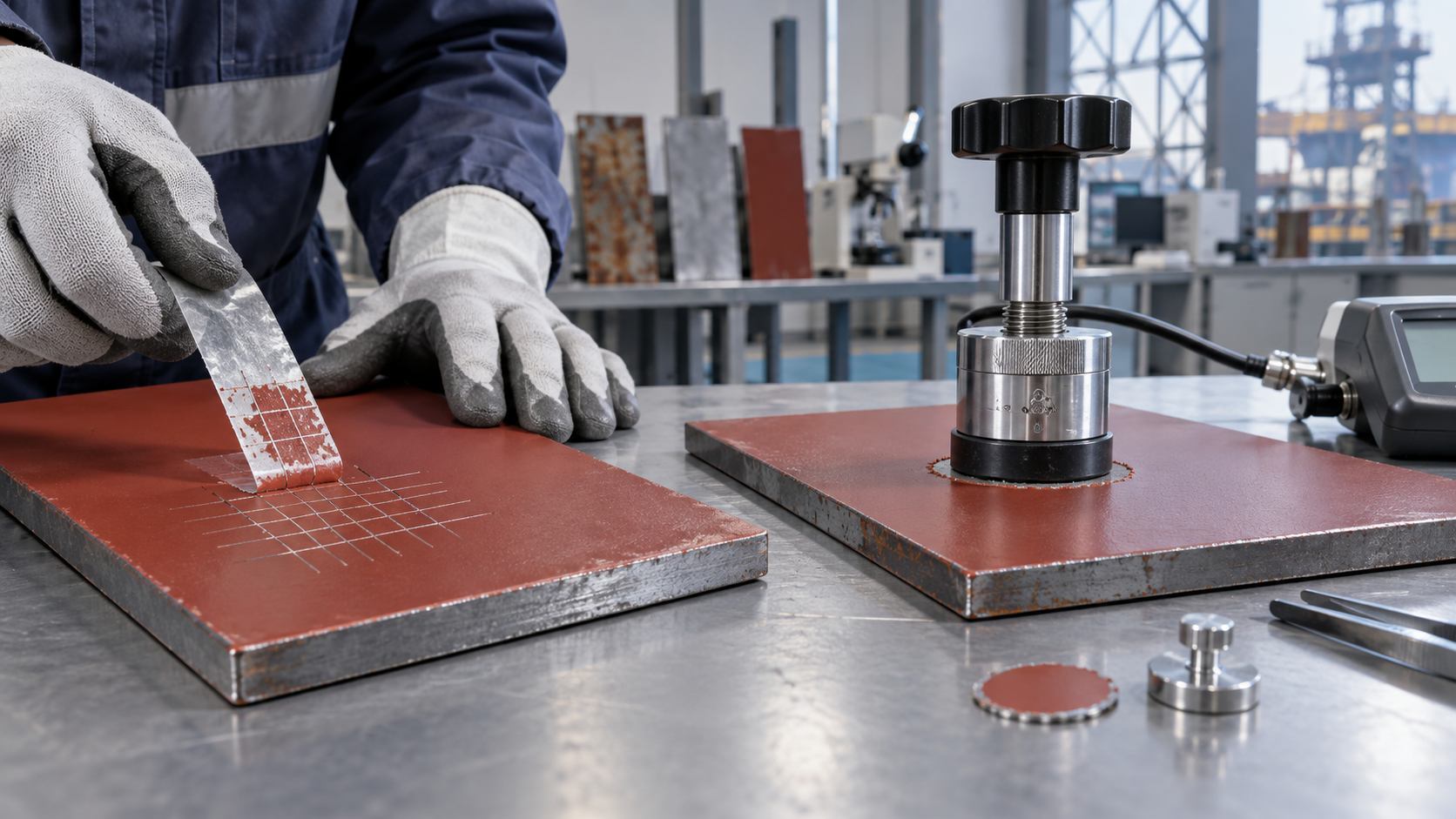
A cross-cut test involves making sharp slices right through the coating. It then checks how much paint peels away from that sliced pattern. Tape-based checks remain very popular today. They offer a quick way to handle daily quality-control tasks.
How Does ASTM D3359 Apply to Coated Steel?
ASTM D3359 explains the tape-test steps used to rate fairly flexible coatings on metallic substrates. The current ASTM D3359-23 standard outlines two distinct test methods. It also points out that this setup works best for checking lower adhesion levels. It is not meant to spot tiny differences between highly secure coatings.
Similarly, ISO 2409:2020 relies on a cross-cut grid to judge how well the paint resists peeling. The ISO standard clearly states that this process does not directly measure true adhesion strength. Instead, it tells users to follow ISO 4624 if they need a precise numerical value.
For industrial buyers, cross-cut testing works wonderfully for basic sorting or simple pass/fail checks. It does not provide an actual tensile strength number.
When Is Cross-Cut Testing Useful?
Cross-cut testing shines during regular factory audits and incoming material inspections. It also helps when comparing test panels made under identical conditions. Buyers must always make sure the chosen test matches their specific coating thickness and overall surface state.
What Does Pull-Off Adhesion Testing Measure?
Pull-off testing applies a direct pulling force straight up from the coated surface. A small test dolly gets glued tightly to the paint. Then, a portable testing device pulls on it until the paint breaks or a set pressure limit is hit.
How Is Pull-Off Different from Cross-Cut Testing?
ASTM D4541 details the pull-off strength testing of coatings on stiff substrates using portable adhesion testers. The final result reveals the exact force needed to break the bond. Meanwhile, looking at the broken surface helps pinpoint the weakest layer in the whole system.
Likewise, ISO 4624:2023 defines specific pull-off techniques intended for both single-layer and multi-coat paint setups.
Unlike a basic cross-cut rating, pull-off testing delivers a clear numerical tensile score. This feature makes it highly valuable whenever a project specification demands an exact, measurable adhesion value.
Why Does the Failure Location Matter?
Looking at the number alone is never enough. Sometimes the glue on the dolly breaks while the paint stays firmly on the steel. In that case, the test only found the limit of the glue, not the paint. On the other hand, if one paint layer peels away from another layer, the real weakness exists inside the coating build-up itself.
Because of these factors, industrial buyers need to write down both the measured force value and the exact location of the break.
Which Adhesion Test Should Industrial Buyers Specify?
The ideal testing method simply depends on what the buyer actually needs to discover.
When Is Cross-Cut a Better Fit?
Cross-cut testing is generally much simpler and faster to perform. It fits perfectly into daily production quality control routines. It also works well for comparing items against an approved master sample. Furthermore, it suits any project where a basic category rating is totally sufficient.
When handling repeat orders, workers must keep things consistent. They should use the exact same steel preparation, film thickness, and drying conditions. The testing steps must also stay identical from one batch to the next.
When Is Pull-Off a Better Fit?
Pull-off testing becomes the better choice when project rules demand a strict numerical strength value. It is also required when engineers need deeper details about where the physical break happened.
Initial qualification trials and high-stakes protective coating systems often justify buying this extra equipment. However, people should never casually compare results taken from different testing devices or different base metals.
How Should Buyers Make Test Results Comparable?
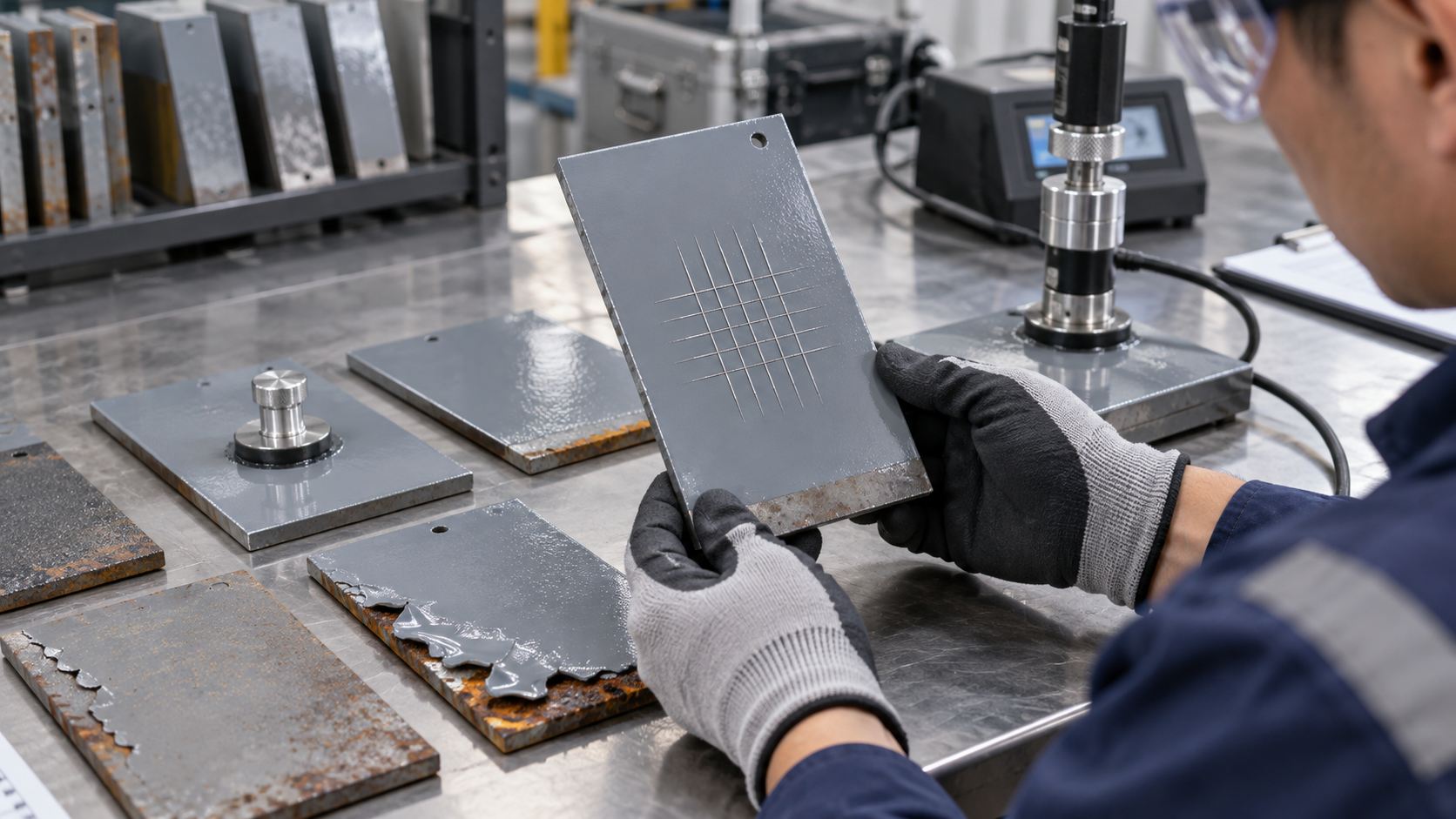
Test scores only hold real meaning when all the surrounding environmental conditions remain strictly controlled.
What Should Be Recorded in the Report?
A helpful testing report must clearly identify the steel substrate and the surface prep method. It should also list the coating batch, dry film thickness, curing climate, chosen test method, and the specific equipment used. Finally, it must show the end result. Pull-off reports need to describe the exact failure mode. Meanwhile, cross-cut documents should state the category rating or the pass/fail standard.
Why Should Surface Preparation Match Mass Production?
A flawlessly prepared lab panel might display outstanding adhesion. However, real factory parts could still fail if they receive uneven or sloppy surface preparation.
Workers can apply KONAZ Anti-Rust Paint using a spray gun, a brush, or a standard roller. It offers a theoretical coverage rate of roughly 6–8 m²/kg for each coat. Test panels must undergo the exact same preparation and painting steps planned for the main production run. This ensures the final test result truly matches the finished commercial product.
Why Should Adhesion and Corrosion Tests Be Used Together?
Adhesion tests and salt spray trials answer completely different questions. Salt spray testing examines how the paint behaves inside a controlled, highly corrosive space. On the other hand, adhesion testing measures how tightly the paint film grips the metal. It checks the exact force needed to tear it off.
A specific paint might do perfectly well in one test but fail miserably in the other. In projects where both corrosion resistance and strong mechanical bonding matter, buyers must clearly define both targets. When needed, they should also compare the adhesion strength both before and after the environmental exposure.
Why Choose KONAZ as an Anti-Rust Paint Supplier?
KONAZ provides premium anti-rust coatings for steel structures, heavy machinery, pipelines, tanks, large ships, and exposed outdoor metal pieces. Its Anti-Rust Paint is expertly crafted to deliver powerful adhesion alongside excellent corrosion resistance. Users can easily apply it via spray, brush, or roller. For large industrial jobs, buyers can coordinate the surface preparation, film thickness, drying rules, and testing needs well before starting bulk production.
Conclusion
Both cross-cut and pull-off tests offer great value for checking anti-rust paint adhesion on steel surfaces. However, they address entirely different technical questions. Cross-cut methods give a very practical category rating or a fast pass/fail answer. Meanwhile, pull-off methods deliver a precise numerical tensile score. They also help locate the weakest layer within the paint system. Industrial buyers need to pick the right method based on project rules, coating type, and overall risk level. No matter which test you choose, you must strictly control the steel prep, film thickness, and drying environment. The tools and passing rules must also stay consistent. This careful control ensures all results remain comparable and truly relevant to your mass production.
FAQs
1. Is a cross-cut test the same as a pull-off adhesion test?
No, they are different. Cross-cut testing looks at paint separation around deliberate surface cuts. In contrast, pull-off testing measures the actual upward tensile force.
2. Which test is better for routine factory quality control?
Cross-cut testing is usually much simpler for everyday factory checks. Pull-off testing becomes the better option when you absolutely need a measurable numerical adhesion value.
3. Should adhesion be tested before or after salt spray exposure?
Doing both tests can be highly beneficial if the project’s risk level demands it. This direct comparison clearly shows whether the harsh corrosion exposure actually weakened the initial paint bond.