
"Mask the holes" names neither the holes nor the depth to protect. Even the entrance edge is open to interpretation. Those details belong in a high temperature powder coating specification before masking is selected. A trial using the intended mating parts can show whether the drawing and masking method preserve assembly fit.
Define Which Surfaces Must Remain Uncoated
Consider a hypothetical order for oven brackets finished with high temperature powder coating. Pick up the assembly drawing: it shows mounting holes and a face that seats against another component. A photograph showing the colour says little about the coating allowed on those features. That information belongs on the drawing.
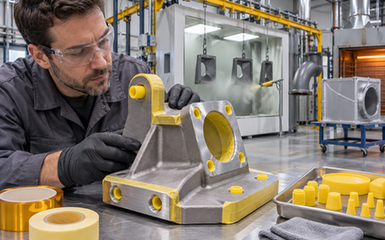
Threads and Holes
On that drawing, one hole might provide clearance around a bolt; another might be tapped. A precision bore could be there to locate a separate component. The clearance hole might accept a film and still leave room for its bolt. The designer has to work through the tolerance and function of the other features separately. Their shared round shape does not make the coating decision the same.
Once a hole is marked for masking, look at its section view. The instruction needs a protected depth. It also needs to say whether the chamfer is bare. Without an answer, the coater may protect the internal thread yet leave coating around the mouth, where the fastener must enter.
Mating Faces and Sealing Areas
The bracket’s mating face needs its own decision. Coating may be acceptable within the assembly tolerance, or the design may require exposed metal. A sealing area needs consideration of the seal as well. There is no reason to apply one masking rule to every flat face.
The words "keep the flange clean" could describe several different boundaries. A dimensioned view gives the coater a much clearer instruction. The drawing review should also address protection of the exposed area afterwards, since it will have no powder film over it.
Choose Masking for the Actual Coating Process
Those drawing decisions give the coater something specific to match. A catalogue’s "high temperature" label still leaves questions about the mask’s shape and the stages it must pass through.
Match the Mask to the Feature
The coater can now compare the available masking shapes with those drawing details. A plug for the hole and tape for the mating face are possibilities; a projecting feature may need a cap. On the bracket itself, check how each item sits. An item that looks suitable in the catalogue may leave a gap at a shoulder or an irregular edge.
Can the operator insert it without difficulty and retrieve it afterwards? Check retention too. If the operator needs to pull a mask through from the opposite side, a blind hole rules that method out. Equal diameters alone cannot tell you which item to order.
Check Exposure Through the Line
When is the mask fitted? If it stays on during cleaning or pretreatment, those exposures belong in its selection. The bake needs its temperature and duration considered together. The component’s eventual operating temperature does not answer either question; temporary masking is normally gone by then.
KONAZ’s explanation of powder curing and service temperature separates the two coating specifications. Keep the masking material’s rating separate again. The masking supplier needs the actual process conditions before recommending its tape, adhesive or plug material.
Approve the Coating Boundary on a Trial Part
There is more to the trial than seeing whether the plug fits an uncoated hole. Put the proposed masking through the planned line process. Agree its removal stage, allow safe handling, and inspect what remains on the component.
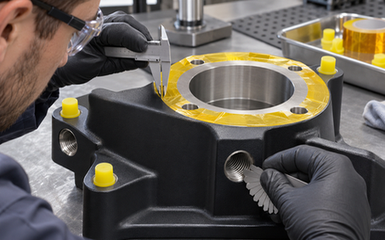
The bracket’s hole mouths and face edges are useful places to start. Has powder reached a protected area? Is there residue, or coating damage from removal? Check the dimensions or threads by the method specified for the drawing, then check assembly where required. If the instruction calls for a thread gauge, simply forcing a bolt in does not give the same evidence.
A failed fit sends the trial back for investigation. Compare the result with the intended mask position and look for movement or leakage. There may be a material-selection problem, or the drawing could need revision. Scraping away coating on the sample without recording a correction leaves production with the original problem. Any repair needs its own approval.
Carry the Approved Detail into Production
The approved sample becomes useful only when the production instruction captures what made it acceptable. Record the drawing revision, masking item and size, placement reference, removal stage and inspection method. A photograph can clarify orientation, but it should accompany the dimensional requirement.
Include these details with the powder coating RFQ information when comparing coating work. Masking labour and inspection belong in the agreed scope. Where masks are reused, the coater also needs a condition check; a worn or damaged sealing edge cannot be assumed to reproduce the trial result.
Discuss the Powder Specification with KONAZ
KONAZ offers heat resistant powder coating for exhaust components, ovens and industrial equipment, including custom formulation and bulk supply options. The component’s operating conditions help start a powder enquiry. If ordering powder separately from coating work, retain the masking detail with the coater’s order too.
Conclusion
The sample approval should leave production with an instruction it can repeat. Keep the drawing acceptance and approved masking detail together. When a later batch has a fit problem, the coater then has an agreed boundary and method against which to investigate it.
FAQs
Can ordinary packaging tape be used for masking?
Sticking it onto an unheated bracket is not a sufficient trial. The tape supplier needs to confirm that both backing and adhesive suit the stages where the tape remains fitted, including removal.
Must every bolt hole remain uncoated?
Have the designer identify which holes can accept a film within their tolerances. An instruction covering only the threads should not be read as a decision about all the other holes.
Should parts be machined after powder coating?
Only where that operation is specified and its effect on the coating is accepted. Post-coating machining is a separate production decision, not an automatic repair for poor masking.


