
How much epoxy floor paint should go into the mixing container? The warehouse’s total area cannot answer that on its own. You also need the mixing instructions and a realistic idea of what the crew can finish. That is worth settling before anyone opens the hardener. Once the components meet, a delay at the doorway still counts as time spent with mixed paint.
Confirm the Mixing Instructions for the Selected Epoxy
KONAZ’s epoxy floor paint comes in 20 kg two-component sets. There is useful ordering information in that line, but no mixing ratio or pot life. Get those details for the product being delivered. An installer cannot work them out from the combined pack weight.

Resin and Hardener Ratios
Look for the basis of the ratio as well as the numbers. Does the instruction say weight or volume? Different component densities mean that a ratio measured on scales may not give the same proportions in a jug. Write the stated method on the mixing instruction where the operator will see it.
Complete matched sets leave less to measure. For partial sets, check that the product permits division and how portions must be measured. The ratio remains the one on the instructions. Putting in more hardener because the shift started late, or because the building is cold, changes what the crew is applying.
Pot Life and Induction Time
Pot life describes how long the mixed material can be used under the stated conditions. Some products also require an induction period before application. Ask whether that applies here. A figure for drying on the floor answers a different question.
The mixing start belongs on the batch record, together with any required wait. Otherwise, two people may be counting from different moments. Check the conditions attached to the published pot life, too. The amount in the container and its temperature affect epoxy’s reaction; material that still pours has not necessarily remained within its permitted working period.
Match Each Batch to the Area the Crew Can Finish
You may already have an approved warehouse paint quantity estimate. That gives purchasing a total, not a container size for the painter. Where will the next mixture actually go before its working period ends? Mark that section on the plan.
Work Around Edges and Obstructions
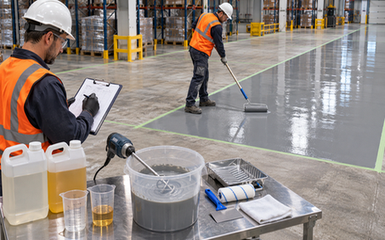
For a hypothetical layout, put an open aisle beside a section containing fixed machines. Give the two sections equal floor areas. Around the bases, the painter has edges to cut in and less room to move. In the aisle, much of that work disappears. The area totals match, yet the crew may need different amounts ready at one time.
Try the arrangement on a prepared section before committing to it across the warehouse. Include the journey from the mixing station when timing the work. If that leaves too little application time, the crew has a specific delay to address. Section boundaries also need to allow the exit route and any wet-edge requirements stated for the product.
Keep Mixing Consistent Between Batches
After the trial, put the agreed method into writing at the mixing station. Someone joining the following shift ought to be able to follow it. They may never meet the painter who mixed the first set.
Check whether either component requires separate stirring before combination. Use clean equipment and the specified mixer, speed and duration. Material against the container wall and bottom must be incorporated; a uniform surface colour alone cannot prove that the whole batch has been mixed. Avoid improvising a mixing time from another epoxy product.
Record the product batch numbers, quantities, mixing start and the section coated. If one area later stays soft, these details help distinguish a particular mixing event from a problem affecting the entire floor. They also give the next shift a useful handover instead of an unlabelled bucket.
Handle Delays Without Changing the Formulation
Suppose the agreed section becomes inaccessible during application. Before allocating that batch elsewhere, check its mixing record against the permitted working period. Waiting for access has used some of that period, even though the roller was stopped.
There is also a reason to check where the mixture waits. Curing produces heat, and a concentrated quantity in a container can hold onto that heat. A film on the floor has more surface exposed through which heat can escape. The supplier’s procedure needs to cover the transfer into application containers. Its safety data sheet belongs with those instructions.
Label an expired batch so nobody picks it up as usable paint. Adding liquid or fresh paint will not reset its age. Any permitted thinning has to come from the selected product’s instructions. Deal with the remainder under the handling and disposal procedure, and clear the interruption before starting another batch.
Plan the Epoxy Order with KONAZ
For a warehouse enquiry, KONAZ offers a two-component product with trowel, roller and spray listed as application methods. Put the contractor’s proposed method on the enquiry. With the quote and mixing instructions available together, purchasing and the installer can discuss the order and the work arrangements using the same product information.
Conclusion
Purchasing may have allowed enough paint already; the remaining issue is how much the crew can use at one time. The trial section and mixing instructions give the installer a basis for that decision. When you contact the KONAZ team, request those product details alongside the supply quotation.
FAQs
Can mixed epoxy floor paint be saved overnight?
There is no basis for planning overnight reuse without an explicit product instruction allowing it. A lid and a storage label cannot reverse the reaction already started.
Can a different brand of hardener be used?
Use the specified pairing unless the resin supplier approves a change. Reading the same ratio on an unrelated hardener pack is not evidence of compatibility with this resin.
Does a longer pot life mean the floor opens sooner?
No. The buyer scheduling installation needs both figures: usable time for the mixture, and the separate cure requirements before the planned traffic returns.


